THE DUST OF SNOW
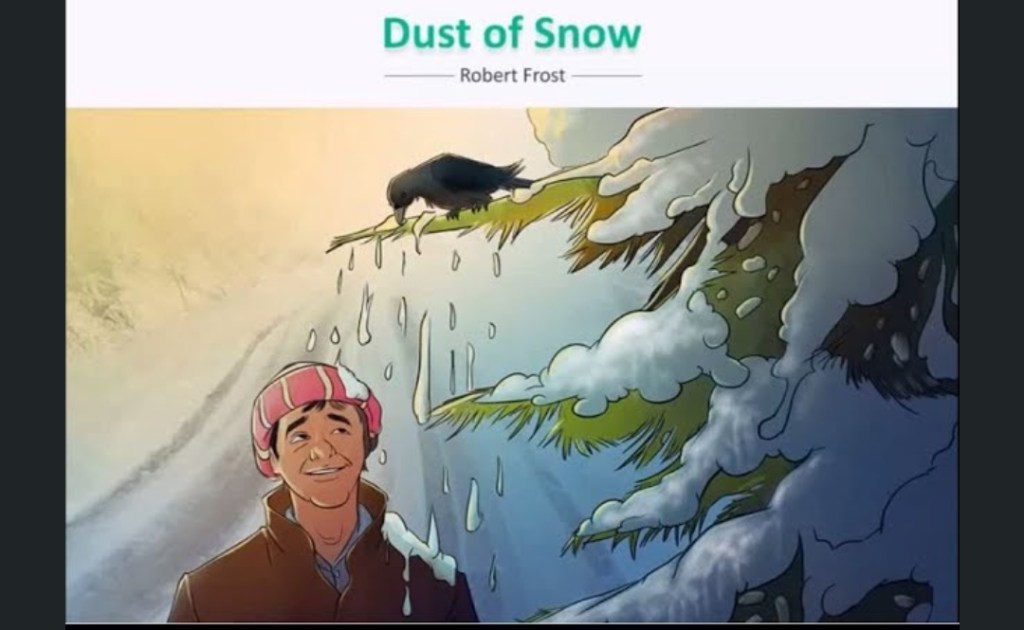
The way a crow
Shook down on me
The dust of snow
From a hemlock tree
Has given my heart
A change of mood
And saved some part
Of a day I had rued.
The poem “Dust of Snow” by Robert Frost is a simple and short poem, yet with a deeper and larger meaning. The poet explains how an act as petty as experiencing snow on one’s body can brighten one’s day up. The message of the poem is put into words by Robert Frost:
“Always, always a larger significance…
A little thing touches a larger thing.”
*DUST OF SNOW LITERARY DEVICES *
Rhyme Scheme- abab cdcd
Alliteration- the occurrence of the same letter or sound at the beginning of adjacent or closely connected words.
The instances of alliteration are as follows-
Has given my heart
And saved some part
Inversion – when the structure of a sentence is changed by the poet to create rhyme, this poetic license is called inversion. In stanza 1 inversion can be seen
Assonance – the prominence of a vowel sound throughout a line is called assonance. In stanza 1, line 2 – “Shook down on me” – ‘o’ sound is prominent.
.
FIRE AND ICE

Some say the world will end in fire,
Some say in ice.
From what I’ve tasted of desire
I hold with those who favor fire.
But if it had to perish twice,
I think I know enough of hate
To say that for destruction ice
Is also great
And would suffice.
Popularity of “Fire and Ice”: This poem was written by Robert Frost, a great American poet. It is a popular literary piece on account of its contradictory subject matter of earth’s destruction and the ending. It was first published in 1920 in New Hampshire. The poem expresses the profound idea that the world would end in one of two ways, either by ice or fire.
As this poem is about the apocalypse, the poet expresses how the world will end. Some people believe that the world will be destroyed by fire, while others argue that it will be frozen. Initially, the speaker also supports those who are in favor of fire. But, as the poem progresses, he remains undecided and mentions that if the world ends twice the ice can bring equal destruction as fire. The poet, very artistically and if we don’t control them, they will surely destroy everything around us.
Fire and Ice literary devices
Assonance: Assonance is the repetition of vowel sounds in the same line such as the long sound of /o/ in “I hold with those who favor fire”.
Alliteration: Alliteration is the repetition of consonant sounds in the same line such as the sound of /f/ in “I hold with those who favor fire”.
Imagery: Imagery is used to make readers perceive things involving their five senses. For example, “Some say the world will end in fire” and “To say that for destruction ice, is also great”.
Symbolism: Symbolism is a use of symbols to signify ideas and qualities, by giving them symbolic meanings different from their literal meanings. “Fire” is the symbol of desires and “Ice” symbolizes hatred. Similarly, “green” and “gold” are the symbol of beauty and happiness.
Anaphora: It refers to the repetition of a word or expression in the first part of some verses. For example,
“Some say the world will end in fire,
Some say in ice.”
Personification: Personification is to give human qualities to inanimate objects. In this poem, “Fire” and “Ice” are capable of destruction. Therefore, the poet personifies fire and ice by giving them a mind which is capable of destroying almost anything.
A TIGER IN THE ZOO
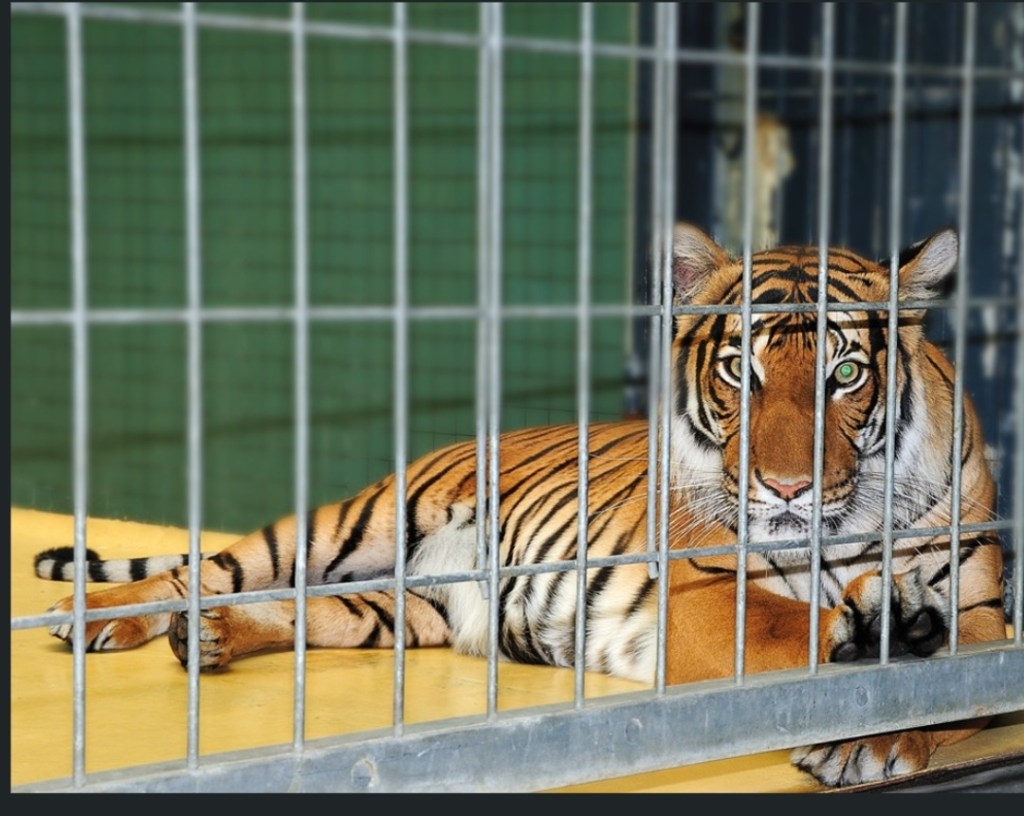
The poem written by Leslie Norris explains the agony and helplessness of a caged tiger that lives in a zoo. The poet explains what his life could be if he had been a free animal. The poet has tried to explain about the condition of animals that are caged by human beings for their own fun.
He stalks in his vivid stripes
The few steps of his cage,
On pads of velvet quiet,
In his quiet rage
Literary devices
Rhyme scheme: abcb (cage-rage)
Personification: The tiger is personified because the poet refers him as ‘he’.
Metaphor: Tiger’s paws are compared with velvet (pads of velvet)
Enjambment: Sentence is continuing to next line without any punctuation mark.
Imagery: poet tries to create an image about the tiger (He stalks in his vivid stripes The few steps of his cage)
Consonance: use of ‘s’ sound (stalks, his, stripes)
Assonance: use of vowel sound ‘I’ (in his vivid stripes)
Oxymoron: use of adjectives opposite in meaning (quiet rage)
He should be lurking in shadow,
Sliding through long grass
Near the water hole
Where plump deer pass.
Literary devices
Rhyme: rhyme scheme is abcb (grass-pass)
Enjambment: Line continues to next line without punctuation marks. (Sliding through….deer pass)
Alliteration: use of sound ‘p’ at the start of two words (plump pass)
Imagery: The poet has tries to create an image of tiger’s activities (lurking in shadow
He should be snarling around houses
At the jungle’s edge,
Baring his white fangs, his claws,
Terrorising the village!
- Literary devices*
Rhyme Scheme: abcb rhyme scheme is followed (edge, village)
Enjambment: Line continues to next line without punctuation marks (He should be snarling around houses At the jungle’s edge,)
Onomatopoeia: using words which denote sound (snarling)
Assonance: use of vowel sound ‘o’ and ‘I’ (should, around, houses), (Baring, his, white, his)
Consonance: use of consonant sound ‘s’ (his, fangs, his, claws)
But he’s locked in a concrete cell,
His strength behind bars,
Stalking the length of his cage,
Ignoring visitors.
Literary devices
Rhyme Scheme: abcb rhyme scheme is followed (bars-visitors)
Personification: The tiger is personified because the poet refers him as ‘he’.
Assonance: use of vowel sound ‘e’ (he, locked, concrete, cell)
Consonance: use of consonant sound ‘s’ (his, strength, bars)
Alliteration: use of sound ‘b’ at the start of two words (behind bars)
He hears the last voice at night,
The patrolling cars,
And stares with his brilliant eyes
At the brilliant stars.
Literary devices
Rhyme Scheme: abcb rhyme scheme is followed (cars-stars)
Enjambment: Line three continues to line four without any punctuation mark. (And stares with his brilliant eyes At the brilliant stars.)
Alliteration: use of sound ‘h’ in the starting of two words (he hears)
Assonance: use of ‘I’ sound (with, his, brilliant)
THE BALL POEM
The poet John Berryman through his poem, ‘The ball poem’ has described the reality of life which everyone has to face one day. He has touched the topic of how to stand up against the miseries and sorrows of life.
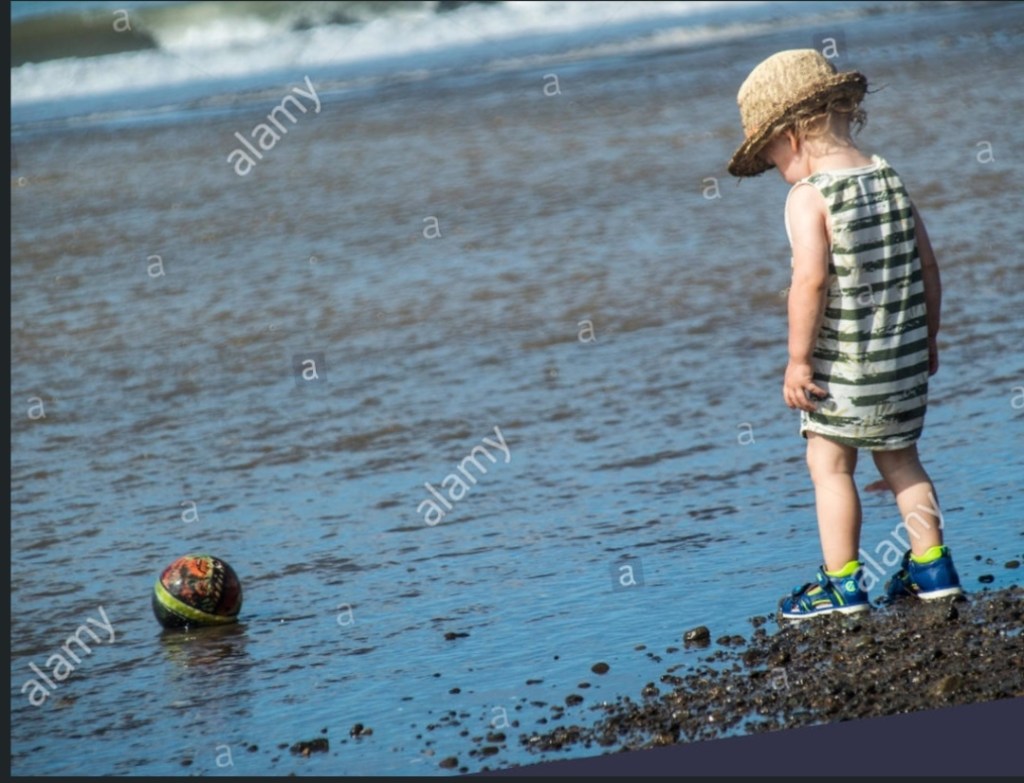
What is the boy now, who has lost his ball,
What, what is he to do? I saw it go
Merrily bouncing, down the street, and then
Merrily over — there it is in the water!
Literary devices
Anaphora: use of repeated words in two or more lines (What is the boy… what, what and merrily bouncing… merrily over)
Assonance: repeated use of vowel ‘o’ (boy, now, who, lost)
Imagery: when poet says merrily bouncing down the street
repetition: ‘what’ is repeated
No use to say ‘O there are other balls’:
An ultimate shaking grief fixes the boy
As he stands rigid, trembling, staring down
All his young days into the harbour where
His ball went. I would not intrude on him;
A dime, another ball, is worthless. Now
He senses first responsibility
Literary devices
Repetition: use of word ‘ball’
Asyndeton: no use of conjunction in a sentence (A dime, another ball, is worthless)
In a world of possessions. People will take
Balls, balls will be lost always, little boy.
And no one buys a ball back. Money is external.
He is learning, well behind his desperate eyes,
The epistemology of loss, how to stand up
Knowing what every man must one day know
And most know many days, how to stand up.
Literary devices
Alliteration: use of sound ‘b’ at the start of two consecutive words (buys a ball back)
Assonance: use of vowel sound ‘e’ (He is learning, well behind his desperate eyes)
Repetition: ‘ball’ word is repeated
Rhyme scheme: There is no rhyme scheme followed in the poem.
 by Kunal Methwani